
When was the synthesizer invented? There is no single date: the RCA Music Synthesizer, unveiled in 1955, was the first instrument to call itself one, while Moog’s modular system (1967) and the Minimoog (1970) made synthesizers commercial.
The answer depends on what you count. Early electronic instruments came first, studio machines followed, and voltage-controlled instruments made the form practical. If you are choosing gear rather than studying history, start with what do I need to make music at home.
Early electronic instruments before the synthesizer
Early electronic instruments proved that electricity could make music, but none of them was a synthesizer in the later sense. The earliest large example was the Telharmonium. Musicians Institute describes it as a 7-ton machine that used motors and telephone receivers around the turn of the 20th century. That makes it a distant ancestor, not a product musicians could buy or carry.
Vacuum-tube instruments
Vacuum tubes brought electronic sound to smaller instruments. Yamaha’s history of the synthesizer says the Audion Piano of 1915 was the first instrument to use vacuum tubes to create sound. It also lists the Theremin (1924) and the Ondes Martenot among the tube-powered instruments. The Philharmonie de Paris story on Google Arts & Culture dates the Theremin to 1922 and adds the Trautonium. The two sources disagree on the Theremin, so a date of 1922 or 1924 depends on which one you follow.
Treat these instruments as precursors. They show electronic pitch and timbre could be controlled, but the idea that defines a synthesizer came later. Harald Bode’s Sound Processor (1960) defined the concept of using separate sound-producing and modifying modules to create tones, according to Yamaha. That modular concept is the thread that leads to the instruments below.
The RCA studio synthesizer
The first instrument to call itself a synthesizer was the RCA Music Synthesizer, a studio machine rather than a stage instrument. Yamaha says it was unveiled in 1955 as a joint experiment in sound production and manipulation between Princeton University and Columbia University.
The Philharmonie de Paris story credits Harry Olson and Herbert Belar with creating RCA’s first synthesizer and dates its development to 1952. Both dates are defensible: 1952 for the development, 1955 for the public unveiling. The RCA Mark II at Columbia used a paper tape reader as its sequencer, according to Musicians Institute. It was a programmed laboratory instrument, a long way from something a band could tour with.
Voltage control: Moog, Buchla and their contemporaries
Voltage control turned the synthesizer from a laboratory machine into a modular instrument that individual musicians could patch and play. Robert Moog’s route to it can be followed in stages:
- Academic start. Moog came to Ithaca, New York in 1957 to begin his PhD work at Cornell University.
- A first workshop. A storefront opened in 1963 in Trumansburg, New York. That site later became the factory where the Moog modular synthesizer and the Minimoog were born.
- Prototype. A first modular synthesizer labelled Prototype followed in 1964, developed with academic support.
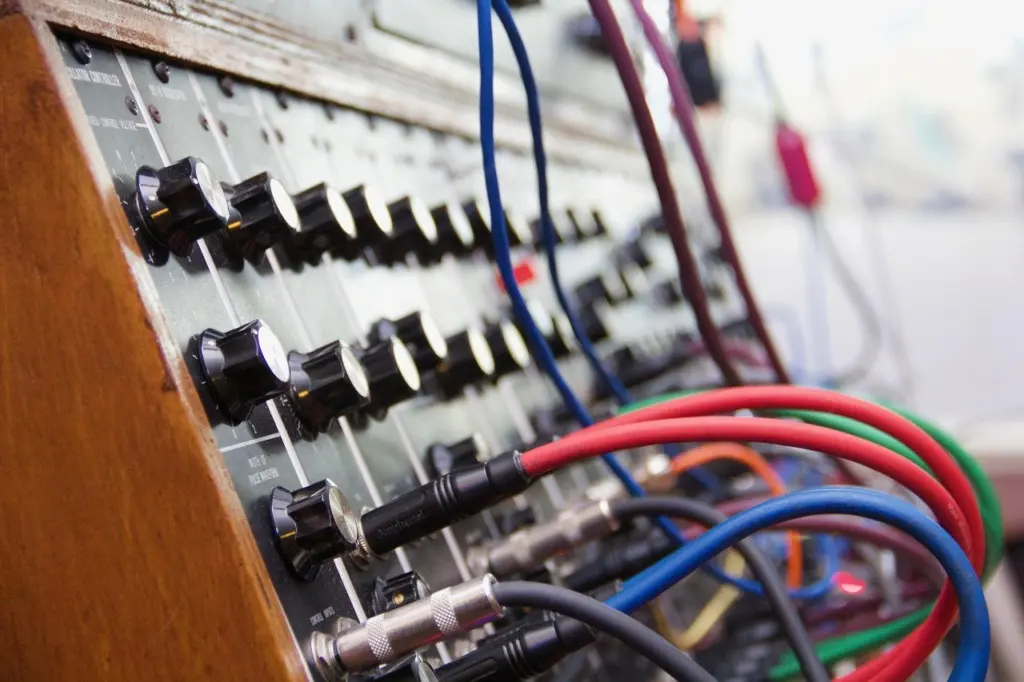
- Production. In 1967 Moog began producing the Moog Modular Synthesizer, which integrated multiple control-voltage components with modules connected by patch cords, according to Yamaha.
- Public breakthrough. Wendy Carlos’s Switched-On Bach was realised in 1968 using an early Moog Modular, a record that showed what the instrument could do musically.
Moog’s lasting contribution was standardisation as well as hardware. Yamaha notes that his designs set standards for the industry, such as 1 V per octave control-voltage tuning. Musicians Institute describes Moog as pioneering some of the first and longest-standing analog synthesizers.
Don Buchla was experimenting with the same voltage-control concepts in parallel. Yamaha says he took a different approach, foregoing a keyboard altogether and focusing on timbral and gestural control. His instruments were nowhere near as commercially successful as Moog’s, but they were innovative and were used by avant-garde composers.
Others were building too. The Philharmonie de Paris story calls Paolo Ketoff’s Synket a pioneer that included elements later used in most synthesizers. It also says EMS’s VCS-3 was the first synthesizer with non-separated, pre-wired modules.
Timeline of key instruments
Use this table to separate precursors, studio machines and instruments that behave like the synthesizers you can still buy or use today.
| Year | Instrument | What it was | Planning use |
|---|---|---|---|
| 1915 | Audion Piano | First instrument to use vacuum tubes to create sound | Count as a precursor, not a synthesizer |
| 1922 or 1924 | Theremin | Early tube-powered electronic instrument; the date varies by source | Cite the year with its source, since sources differ |
| Early | Ondes Martenot | Early electronic instrument | Precursor |
| Early | Trautonium | Early electronic instrument | Precursor |
| 1955 | RCA Music Synthesizer | Princeton-Columbia experiment; first instrument to call itself a synthesizer | Best answer to “first synthesizer” by name |
| 1960 | Bode Sound Processor | Defined separate sound-producing and modifying modules | The concept behind modular design |
| 1964 | Synket | Paolo Ketoff’s pioneering instrument with elements later common in synthesizers | A parallel Italian development |
| 1967 | Moog Modular Synthesizer | Production began; patch-cord modules with control voltage | Start here for the first widely used modular synthesizer |
| 1969 | EMS VCS-3 | First synthesizer with non-separated, pre-wired modules | Shows the shift away from separate modules |
| 1970 | Minimoog; ARP 2500 | Performer-oriented Minimoog; large voltage-controlled monophonic modular ARP 2500 | The point where compact and large systems coexisted |
| 1974 | Oberheim SEM | Unveiled by Tom Oberheim when he founded Oberheim Electronics | Marks growing competition after Moog |
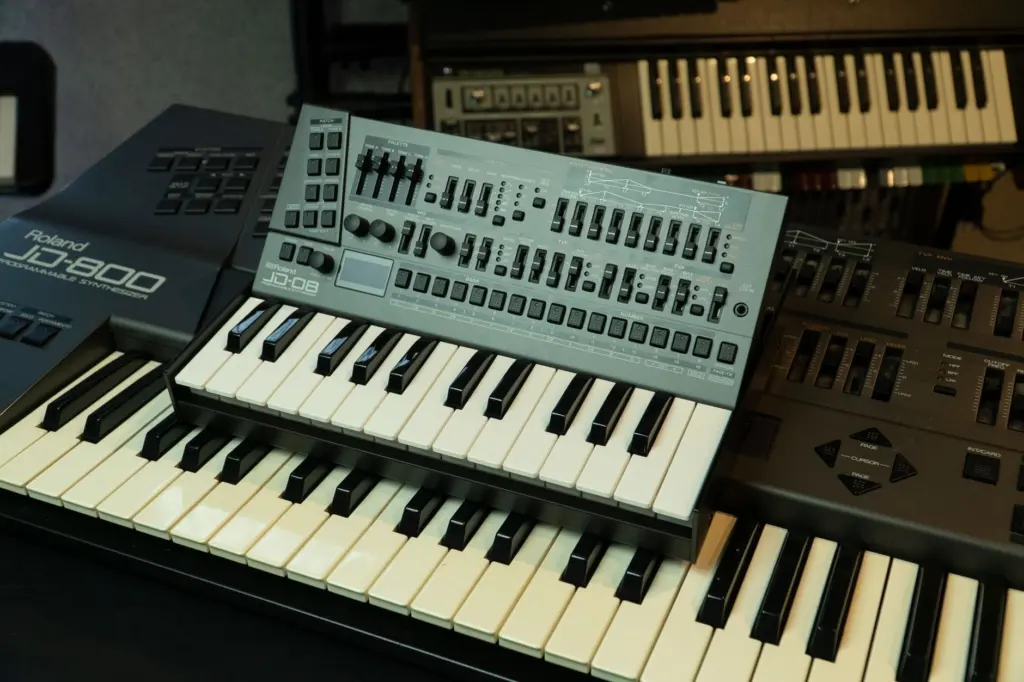
| 1982 | Yamaha DX7 | The first digital synthesizer | Where the analog era gives way to digital |
Dates and descriptions come from Yamaha’s history of the synthesizer and the Philharmonie de Paris story on Google Arts & Culture.
RCA, Moog and Buchla compared
The three designs answer different questions, and the right one to study depends on what you want to understand.
- RCA: the studio-first machine. A joint Princeton-Columbia experiment, built by Harry Olson and Herbert Belar, and sequenced with paper tape at Columbia. It shows how synthesis began, not how musicians later worked.
- Moog: integrated, standardised modules. Patch-cord-connected modules combined control-voltage components, and the 1 volt per octave standard followed. Study this one to understand the lineage of later analog instruments.
- Buchla: control without a keyboard. Buchla chose timbral and gestural control over a keyboard. His instruments sold far less than Moog’s but were used by avant-garde composers, so they matter for the history of alternative controllers.
For a practical lineage to the instruments on sale today, follow Moog. For the idea of what a synthesizer could be beyond a keyboard, Buchla’s approach is the more instructive contrast.
Minimoog and the commercial boom
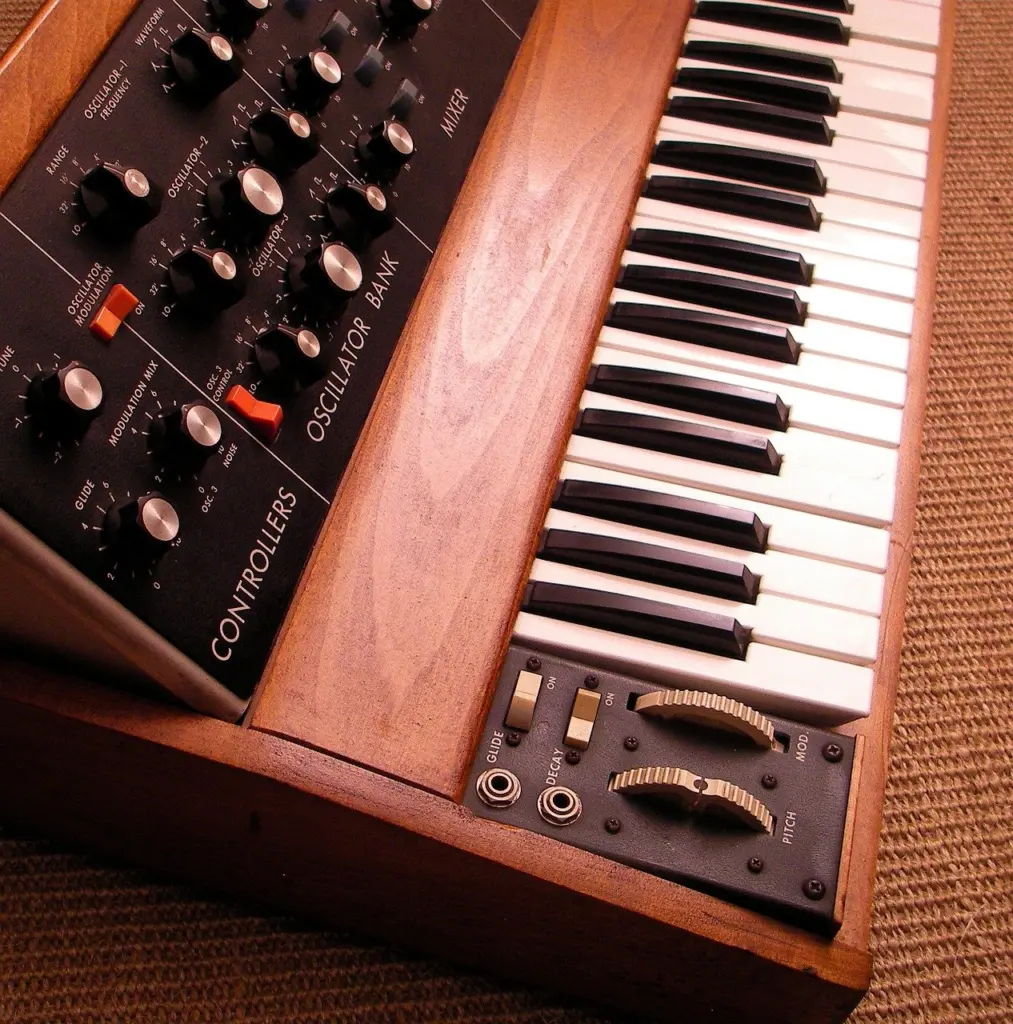
The Minimoog made the synthesizer a performer’s instrument. Yamaha says the R.A. Moog Company (later Moog Music) unveiled it in 1970 as a watershed instrument, pre-wired and aimed at performers. A history of Moog’s development describes it as a compact package that included the most important parts of the modular synthesizer. That removed the patch cords that the modular system required.
It also introduced two real-time controllers, a pitch bend wheel and a modulation wheel, which Yamaha says have since become standard on synthesizers everywhere. If you are looking at a modern keyboard, those wheels are the Minimoog’s most visible legacy.
The Minimoog arrived in a crowded year. ARP debuted its large voltage-controlled monophonic modular ARP 2500 in 1970, and Tom Oberheim unveiled the SEM in 1974. Moog sold the company in 1971, after the Minimoog’s introduction, according to Matrixsynth. Taken together, these dates show a market forming quickly after the Minimoog’s unveiling.
How modern synthesizers differ from early ones
The biggest change is that sound generation moved from analog circuits to digital processing. The Philharmonie de Paris story says Yamaha’s launch of the DX7 in 1982 was the first digital synthesizer. Musicians Institute adds that the DX7 was the first synthesizer to embrace FM synthesis.
Early instruments such as the Moog Modular worked through patch-cord connections and control voltage. The DX7 shows that the sound itself could be generated and shaped differently. Even so, controls pioneered in the analog era survived: the pitch bend and modulation wheels are still standard on synthesizers.
If you want to see how electronic sound shaping is applied to voices, What Is a Vocoder? A Clear, Practical Guide to How Vocoders Work and How to Use Them in 2026 – Soniqcast covers it. To connect a modern keyboard to a computer, see What Is MIDI Over USB? A Practical Guide To Connecting Instruments In 2026 – Soniqcast.
Frequently asked questions
Who invented the synthesizer?
No single person did. Harry Olson and Herbert Belar are credited with RCA’s first synthesizer, Harald Bode defined the separate-module concept, and Robert Moog and Don Buchla developed voltage-controlled instruments. Moog’s became the most commercially successful.
Was the Minimoog the first synthesizer?
No. It was unveiled in 1970, well after the RCA Music Synthesizer of 1955 and Moog’s own Modular Synthesizer of 1967. Its importance is that it was a pre-wired instrument for performers.
Is the Theremin a synthesizer?
It is better described as an early electronic instrument. Yamaha lists it among tube-powered instruments, and the RCA Music Synthesizer was the first to call itself a synthesizer.
What did Robert Moog contribute that others did not?
Moog’s designs set standards for the industry, including 1 volt per octave control. He also brought both the modular system and the compact Minimoog into commercial production.



Leave a Reply