
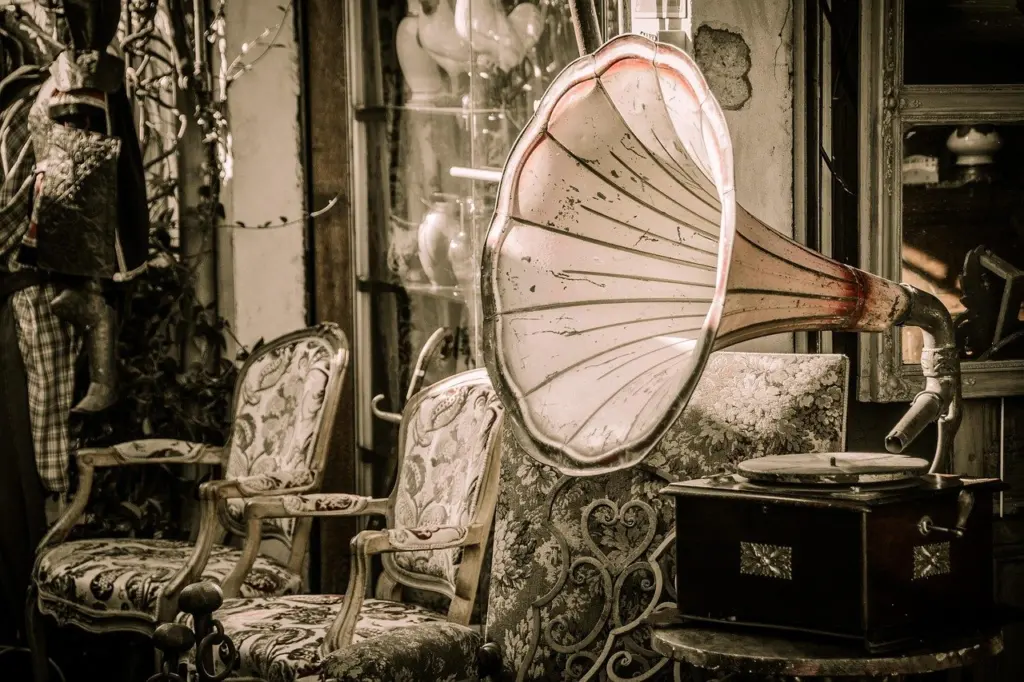
Quick answer: When was the record player invented? Thomas Edison’s phonograph of 1877 recorded and played back sound, and Emile Berliner’s gramophone, patented in 1887, introduced the flat disc that modern turntables still play.
The dates below separate the phonautograph, phonograph and gramophone, then turn that history into buying advice. Once the record side is sorted, the best headphones for music are covered in the wider best headphones for music section of our Audio Equipment Buying Guide.
Phonautograph, phonograph and gramophone: who invented what
Different inventors built each of these machines, and each did a different job. The phonautograph recorded sound but could not play it back, the phonograph recorded and played back on cylinders, and the gramophone played flat discs. Which one you call the first record player depends on whether you count playback or the disc format.
The phonautograph (1857): recording without playback
Scott de Martinville created the phonautograph in France in 1857, and he patented it in the same year. The device inscribed sound, but it could not play sound back. That makes it an important forerunner of recording rather than a record player in the everyday sense, because nobody could listen to what it captured.
Edison’s phonograph (1877): the first playback machine
The US National Park Service, which interprets Edison’s laboratory, states that the first phonograph was invented in 1877 at the Menlo Park lab. The earliest records were cylinder-shaped, with the music on the outside. This is the answer most people want when they ask who invented the phonograph: Thomas Edison, in 1877.
The cylinder format kept developing after Edison. Alexander Graham Bell added wax to Edison’s phonograph design to record waves of sound, and the result was called the graphophone. Wax cylinders were still in use up until the 1920s, so the cylinder and the disc overlapped for decades.
Berliner’s gramophone (1887): the flat disc
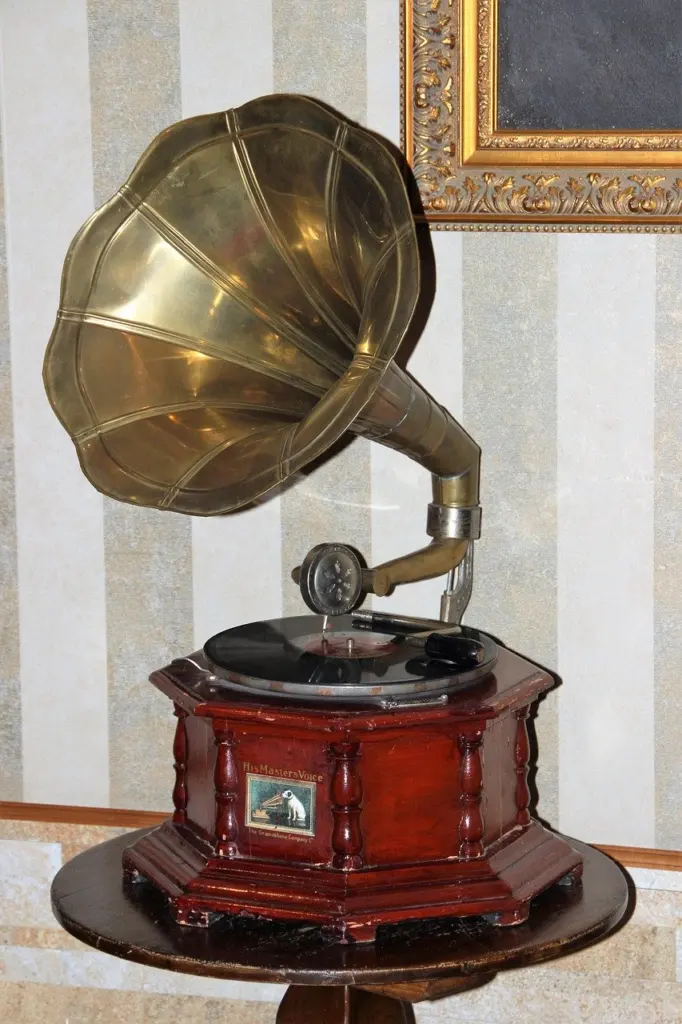
Emile Berliner, a German-born inventor, was granted a patent for what he called the gramophone in 1887. Unlike the graphophone, the gramophone used flat discs, or records, rather than cylinders. The two names are therefore not interchangeable: the phonograph belongs to Edison and cylinders, while the gramophone belongs to Berliner and discs.
If your question is about the machine that plays the records in a modern collection, Berliner’s disc is the ancestor. If your question is about the first machine that could reproduce a recorded voice, it is Edison’s phonograph.
Dated timeline from 1857 to the present
The sequence below shows how recording, playback, discs and electric power arrived in turn. Each stage is explained further in the sections that follow.
- 1857, phonautograph: recording only, with no playback.
- 1877, phonograph: invented at the Menlo Park lab using cylinders.
- 1887, gramophone: Berliner secured a patent for the flat-disc machine.
- 1906, Victrola: a device designed to fit in the home.
- 1920s, electric motors: they replaced the need for hand cranking.
- 1948, vinyl LP: Columbia Records introduced the long-playing record.
- 1958, stereo LP: the first mass-produced stereo LP came out.
- Today, modern turntables: they include USB connectivity and built-in preamps.
From hand-cranked horns to electric turntables
Record players changed from mechanical to electric in stages: the format moved from cylinder to disc, the drive moved from hand power to a motor, and the signal path gained electronics. Each change removed a chore for the listener.
The disc made the machine easier to live with. The Victrola, introduced in 1906, was a device designed to fit in the home and used 10 inch discs, so the record player moved from a laboratory curiosity to furniture. The next step was power. Electric motors arrived in the 1920s and ended the need to turn a crank to spin the record.
The most recent step is in the electronics. Modern turntables add USB connectivity and built-in preamps, which matter when you choose a model today. The core mechanism is still a stylus riding a groove on a rotating record, which is why a turntable bought now has so much in common with an early gramophone.
Shellac 78s, vinyl LPs and how the formats compare
The shellac 78 was the standard commercial disc, and the vinyl LP changed what a disc could hold. Discs of the shellac era rotate at 78 rotations per minute (rpm), and that speed became the standard for these records. A side held roughly 3 minutes, which is why a single piece of music so often had to be split across discs.
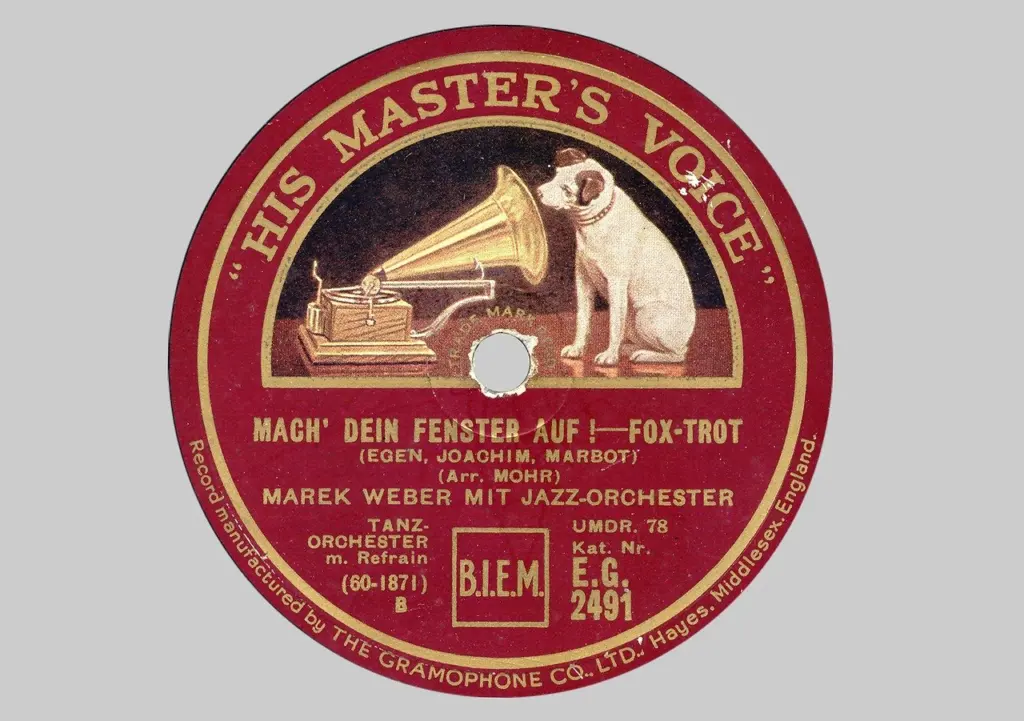
The LP is the answer to the question of when vinyl records replaced shellac. Industry history describes shellac records as reigning supreme until the mid-20th century, when a new material revolutionized the industry. That material was polyvinyl chloride (PVC) plastic, and Columbia Records introduced the vinyl LP in 1948. Goldmark changed the rotation speed to 33 1/3 revolutions per minute, which set a new music industry standard. So 1948 is the date to remember for the LP’s arrival, and the mid-20th century is when shellac’s reign ended.
| Format | Dates | Physical details and speed | Planning use |
|---|---|---|---|
| Wax cylinder | Still in use up until the 1920s | Cylinder rather than a flat disc | Historical context for the disc formats that followed |
| 78 rpm shellac disc | Victrola home player introduced 1906; 78 rpm standard from the early 1900s | 78 rpm; 10 inch disc on the Victrola; roughly 3 minutes per side | Check that a turntable offers a 78 rpm speed before buying it for old discs |
| Vinyl LP | Introduced by Columbia Records in 1948 | 12 inches; 33 1/3 rpm; microgroove; polyvinyl chloride | The standard speed set for the LP, and the baseline for any turntable |
Figures are drawn from the Middle Tennessee State University history of recorded sound and a vinyl history overview.
What to look for in a modern turntable
A modern turntable should match the records you own and the amplification you already have. The history above explains each checkpoint, because speeds, signal level and setup all trace back to how these formats were designed.
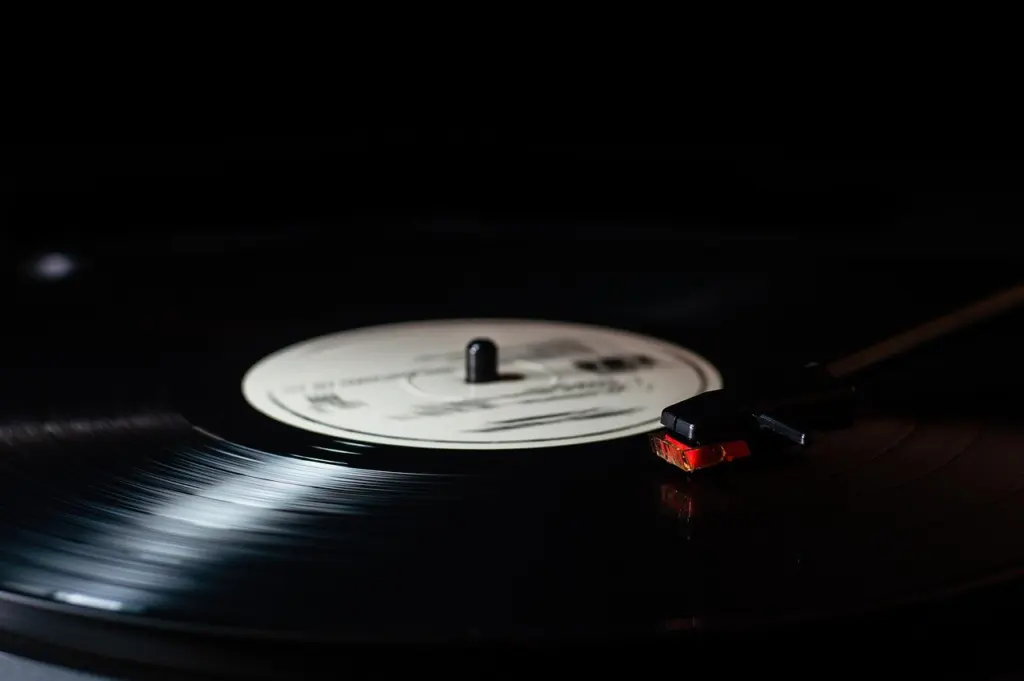
- Playing speeds: LPs rotate at 33 1/3 rpm and shellac discs at 78 rpm. If you only buy modern vinyl, the LP speed is the one that matters. If you inherit old shellac discs, confirm a 78 rpm setting before you buy.
- A phono preamp: vinyl records produce a low-level signal that requires amplification before it can be played. The preamp can be built into the turntable, built into a receiver or amplifier, or sold separately. Check which of those placements your setup already has, so you do not pay for the same function twice.
- Tonearm adjustment: setup includes adjusting the tonearm’s counterweight to achieve the correct tracking force. A tonearm with an adjustable counterweight suits anyone willing to set it up carefully.
- USB output: modern turntables can include USB connectivity alongside built-in preamps. It is worth paying for only if you want that connection, and a built-in preamp is the more broadly useful feature.
If you plan to listen on headphones once the turntable is connected, Does Noise Cancelling Protect Your Hearing? What Science Says And How To Stay Safe In 2026 – Soniqcast covers hearing safety, and Open-Ear Vs Bone-Conduction Headphones: Which Is Right For Your Ears And Lifestyle In 2026 – Soniqcast compares two open-style designs.
Frequently asked questions
Why did Edison’s early recordings wear out so quickly?
The earliest recordings were made on tin-foil. According to the National Park Service, after just a few plays the tin-foil would tear up and the message could no longer be played.
What are shellac records made from?
Shellac is made from a resin secreted by the lac bug. It is a brittle resin, making shellac records breakable, so handle old discs with care.
Is a phonautograph a record player?
No. The phonautograph of 1857 could inscribe sound but could not play sound back, so it is a forerunner of the record player rather than one.



Leave a Reply