
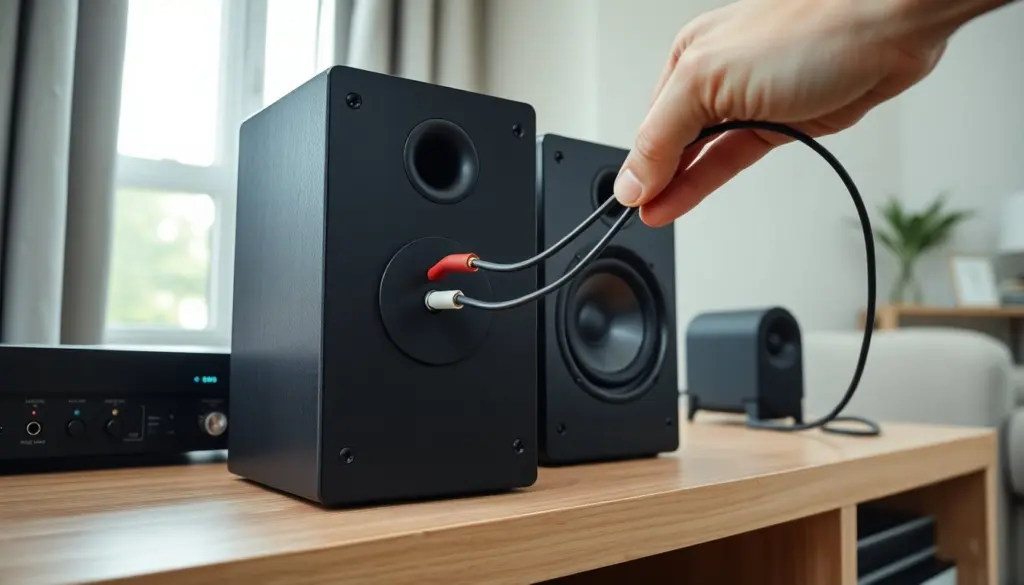
When someone compares series vs parallel speakers, the practical goal is to match speaker impedance and amp load so the system sounds right and stays safe. This article explains how both wiring schemes change total impedance, affect interaction between drivers, and influence amplifier stress. It gives clear wiring examples and safety pointers useful for stereo, home-theater, or multi-room installs.
Key Takeaways
- Series vs parallel speakers wiring impacts total impedance, affecting amplifier load and sound quality.
- Series wiring adds speaker impedances, increasing total impedance and reducing amplifier stress but lowering volume.
- Parallel wiring lowers total impedance, increasing volume and amplifier current demand, which can risk overheating if not managed.
- Choosing series or parallel wiring depends on amp specifications, speaker impedance, and the desired sound balance.
- For multi-speaker setups, series-parallel combinations help maintain safe impedance levels and sound consistency.
- Always verify amplifier minimum impedance and speaker power ratings to ensure safety and avoid damage.
How Series And Parallel Wiring Work: The Basics Every Listener Should Know
Quick Facts
- Series wiring adds impedances: total impedance equals the sum of each speaker.
- Parallel wiring reduces net impedance: total impedance is less than the smallest speaker.
- Amplifier load and power distribution change with wiring and affect safety and sound.
Series Wiring: How It Changes Total Impedance And Signal Flow
In series wiring the positive terminal of one speaker connects to the amplifier, its negative goes to the positive of the next speaker, and so on. That chain means total impedance = Z1 + Z2 + … so two 8 Ω speakers wired in series present 16 Ω to the amp. Series wiring drops more voltage across each speaker as impedance rises, typically reducing loudness but increasing amplifier stability when high impedance is desired. It also makes the speakers interact: if one driver fails or has a different sensitivity, the whole chain’s balance shifts.
Parallel Wiring: How It Changes Total Impedance And Signal Flow
Parallel wiring ties all positives together and all negatives together at the amplifier output. The math uses the reciprocal rule: 1/Ztotal = 1/Z1 + 1/Z2 + …, so two 8 Ω speakers in parallel present 4 Ω. Parallel lowers net impedance and hence draws more current from the amp, potentially increasing volume but also risk. With parallel, each speaker sees nearly the same voltage, so sensitivities determine who sounds louder. Parallel also means a single speaker fault rarely kills the whole channel, unless the amp is overloaded.
How Wiring Affects Sound Quality And Speaker Interaction
Wiring alters both voltage distribution and damping factor, which shape perceived sound. Series wiring raises total impedance and can increase the damping factor seen by each driver, often loosening bass control slightly and lowering overall SPL. Parallel wiring lowers impedance and can improve bass tightness if the amplifier handles the load, but it may produce distortion or thermal shutdown if the amp is stressed.
Crossover networks also behave differently. In series chains, passive crossovers shared between drivers can interact unpredictably: in parallel, each speaker/crossover branch tends to operate independently. For critical listening, matching speaker sensitivity, impedance, and crossover design is more important than choosing series or parallel alone. Practical listening tests, at moderate volumes, help decide which wiring yields the preferred tonal balance.
Power Handling, Amplifier Load, And Safety Considerations
Safety centers on amplifier current limits and speaker power ratings. Parallel wiring reduces impedance and increases current draw: if the amp isn’t rated for that lower impedance, it may overheat, clip, or trigger protection. Series wiring usually increases impedance and reduces current, which can protect the amp but might underutilize its power and push it to produce more heat for the same perceived volume.
Key safety tips: always check the amplifier’s minimum rated impedance, avoid bridging an amp into loads below that rating, and verify each speaker’s power handling. Use proper gauge speaker wire for runs over 15–20 feet to avoid resistive losses. When in doubt, add a small inline fuse or use the amp’s protection features. Clipping under heavy load is a common source of speaker damage: if the sound gets harsh, reduce volume immediately.
Choosing The Right Wiring For Common Setups (2, 4, And Multi‑Speaker Systems)
For 2‑speaker stereo systems, parallel is standard: it keeps each speaker driven independently and usually matches typical amp ratings. If the amp can handle 4–8 Ω loads, two 8 Ω speakers in parallel (4 Ω) are fine. Series is used when the amp requires a higher load or when running simple long-throw public-address lines where higher impedance reduces loss.
For 4‑speaker systems, options include series-parallel combinations to keep the overall impedance within the amp’s safe range. For example, four 8 Ω drivers can be paired in series pairs, then those pairs wired in parallel to present 8 Ω total, balancing load and redundancy. In multi-room or distributed audio, many installers use impedance-matching transformers or constant-voltage systems rather than complex series/parallel wiring to maintain safety and consistent levels.
Step‑By‑Step Wiring Examples And Quick Calculations For 2‑And 4‑Speaker Systems
2‑Speaker Examples:
- Two 8 Ω in series: connect + amp → + speaker A, − A → + B, − B → − amp. Result: 16 Ω total: lower volume, safer on amps that dislike low impedance.
- Two 8 Ω in parallel: tie both + terminals to + amp and both − to − amp. Result: 4 Ω total: higher volume and more current demand.
4‑Speaker Examples:
- Four 8 Ω all parallel: dangerous for most small amps (2 Ω total). Avoid unless the amp supports it.
- Series-parallel balanced: group as (A+B in series) and (C+D in series), then wire those two groups in parallel. Calculation: each series pair = 16 Ω: parallel of those = 8 Ω total. This keeps load friendly to many amps while using all speakers.
Quick Calculation Tips:
- For series: add impedances. For parallel: use reciprocal sums or the shortcut for two equal speakers: Z/2.
- When unsure, aim for total impedance equal to or higher than the amp’s minimum rating. Use a multimeter to verify connections before powering up.
Series vs Parallel Speakers: Frequently Asked Questions
What is the main difference between series and parallel speaker wiring?
Series wiring adds each speaker’s impedance together, increasing total impedance and lowering volume, while parallel wiring reduces total impedance by splitting current among speakers, often increasing volume but risking amplifier overload.
How does speaker wiring affect amplifier safety and performance?
Series wiring increases impedance and lowers current draw, protecting the amp from overload but possibly reducing volume. Parallel wiring lowers impedance, drawing more current and risking amp overheating unless the amp supports low-impedance loads.
Can I connect two 8-ohm speakers in parallel to my home amplifier?
Yes, connecting two 8-ohm speakers in parallel results in a 4-ohm total load. This usually increases volume but only if your amplifier supports a 4-ohm minimum impedance without overheating or distortion.
Why might series wiring be preferred for multi-room audio systems?
Series wiring raises total impedance, reducing power loss over long cable runs and increasing amplifier stability, making it useful for distributed or public-address systems where maintaining safety and minimizing cable loss is important.
How do wiring types influence sound quality and speaker interaction?
Series wiring can loosen bass control and lower loudness due to increased impedance, while parallel wiring can tighten bass and increase volume if the amp handles the load. Speaker sensitivity and crossover design also affect the tonal balance.
What is a safe way to wire four 8-ohm speakers to maintain an 8-ohm load?
Wire speakers in series pairs (two pairs of two 8-ohm speakers each) and then connect those pairs in parallel. Each series pair is 16 ohms, and their parallel connection results in a total 8-ohm load, balancing amplifier safety and power distribution.


Leave a Reply