
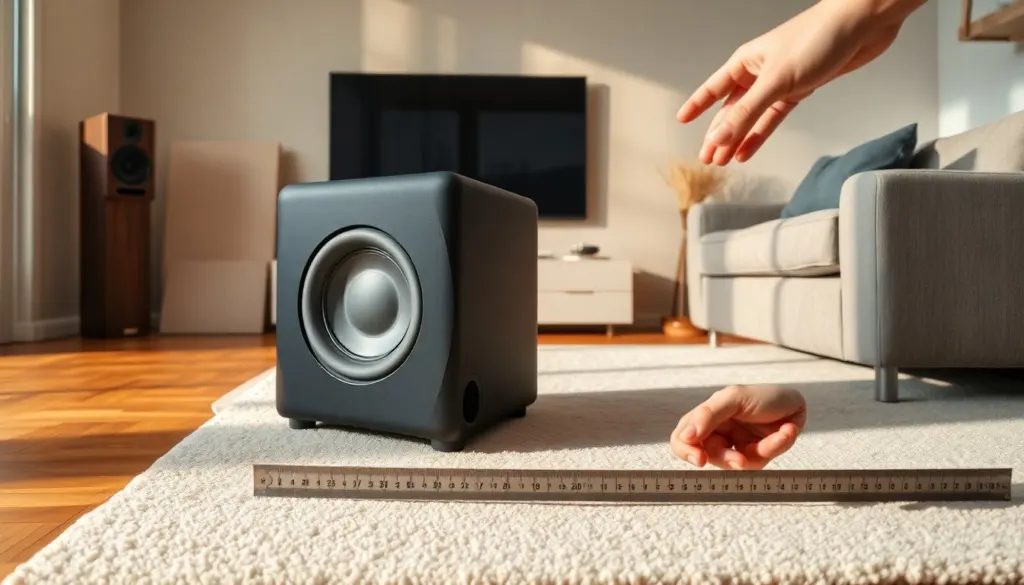
Correct placement of a subwoofer significantly changes how bass sounds in a room. Instead of guessing, a few simple tests and an understanding of room behavior help people get tighter, more even low frequencies. The advice below explains why placement matters, where to start, and how to integrate one or more subwoofers with speakers and room correction for reliable results.
Key Takeaways
- Correct subwoofer placement dramatically improves bass sound quality by reducing boomy or muddy effects and smoothing frequency response.
- Bass interacts strongly with room features, so positioning near corners, front walls, or close to the listener each offers distinct acoustic benefits to test.
- The subwoofer crawl method helps find the ideal spot by placing the sub at the listening position and moving along walls to identify where bass sounds fullest.
- Adding a second subwoofer symmetrically evens out room modes, reducing peaks and nulls over a larger listening area for better bass consistency.
- Proper integration with speakers involves setting the correct crossover frequency, adjusting phase alignment, and using room correction after placement for optimal performance.
Why Subwoofer Placement Matters For Sound Quality
Bass wavelengths are long and interact with room boundaries: as a result, where a subwoofer sits often matters more than its wattage. Placing a subwoofer poorly can create boomy bass, nulls (holes), or muddy decay, while a good position smooths response and increases perceived impact. People should think of the subwoofer as a room-driven component, it radiates into the space and the room shapes what listeners hear, so placement is part of tuning, not just hardware selection.
How Rooms Shape Low Frequencies: Bass Behavior Explained
Rooms emphasize and cancel different bass frequencies depending on dimensions, surface reflections, and furniture. Low frequencies can build up at walls and corners, creating peaks: they can also cancel at specific listening locations, causing nulls. Small rooms typically show more pronounced peaks and dips below about 100 Hz, which is why placement and alignment with the listening position are essential for a usable bass profile.
Room Modes And Standing Waves: What To Listen For
Room modes occur when sound reflects between parallel surfaces and reinforces at specific frequencies. Listeners should listen for notes that sound overly loud, slow to stop, or that disappear entirely when they move. Common signs: bass that booms in one seat but thins in another, or a sustained low note that lingers. Addressing modes begins with placement, then moves to acoustic treatment or multiple subs if needed.
Practical Starting Positions: Corner, Front Wall, And Nearfield Options
Start with three practical positions: corner, front wall (midpoint), and nearfield (close to the listener). Corners usually yield the most output and stronger bass reinforcement but can exaggerate peaks. Front-wall placement (centered left-right or slightly off) provides a balance between power and evenness. Nearfield, placing the sub near the main listening spot, reduces room influence and can tighten bass for critical listening. Try each position briefly to compare tonal balance and decay.
The Subwoofer Crawl: A Simple Step-By-Step Placement Test
- Place the subwoofer at the main listening position and play bass-heavy material at moderate level.
- While it plays, crawl along the front wall and mark the spot where bass sounds fullest.
- Put the sub at that marked spot and return to the listening position to evaluate bass smoothness and timing.
- Repeat with corners and other walls: small adjustments (a few inches) can matter.
- Choose the spot that offers the best overall balance across multiple listening locations.
This method lets people find a room-friendly position without measurements: it reveals peaks and preferred locations quickly.
Using Multiple Subwoofers: When And How To Add A Second Unit
Adding a second subwoofer helps even out room modes and extend smooth bass across a larger listening area. Two subs placed symmetrically (for example, front-left and front-right or front and rear) often cancel severe peaks and fill nulls. When adding a second unit, match level, phase, and crossover settings between them and use room correction if available. Multiple subs aren’t necessary for small rooms with casual listening, but they’re a practical solution for smoothing response in larger rooms or multiseat setups.
Integrating Your Subwoofer With Speakers: Crossover, Phase, EQ, And Room Correction
Set the crossover so the sub hands off to the mains smoothly, often between 60–80 Hz depending on speaker capabilities. Adjust phase so the sub and mains add at the listening position: inverting phase or using the phase control can fix timing cancellations. Use EQ sparingly: target narrow peaks or dips rather than broad boosts. If the AV receiver or a dedicated processor offers room correction, run it after physical placement adjustments: automated systems improve measured response but work best when the sub is already well-sited.
Frequently Asked Questions about Subwoofer Placement
Why does subwoofer placement matter for sound quality?
Subwoofer placement matters because bass wavelengths interact with room boundaries, affecting sound. Good placement smooths bass response and enhances impact, while poor placement can cause boomy or muddy bass and uneven frequency distribution.
What is the best way to start placing a subwoofer in a room?
Begin with practical positions such as a corner, front wall midpoint, or nearfield placement close to the listener. Test each briefly to compare bass tonal balance and decay before choosing the optimal spot.
How does a room affect low-frequency bass from a subwoofer?
Rooms shape bass through reflections and dimensions, creating peaks near walls or corners and nulls at certain listening spots. Small rooms tend to have more pronounced bass peaks and dips under 100 Hz, making placement crucial for smooth bass.
How do I perform the subwoofer crawl placement test?
Place the subwoofer at your listening seat, play bass-heavy material, then crawl along the front wall marking where bass sounds fullest. Move the subwoofer to that spot and evaluate bass smoothness. Repeat for corners and other walls to find the best overall placement.
Can adding a second subwoofer improve bass quality?
Yes, adding a second subwoofer placed symmetrically helps even out room modes, reduces peaks and nulls, and provides smoother bass across more seats. Ensure matched level, phase, crossover, and use room correction for best results.
How should I integrate my subwoofer with main speakers for optimal sound?
Set the crossover between 60–80 Hz to blend the sub with mains smoothly, adjust phase to align timing, and use EQ sparingly on narrow peaks or dips. Run automated room correction after physical placement for the best balanced bass response.



Leave a Reply